Introduction
The United States is now officially in an economic recession and has been since December 2007 (NBER, 2008). The effects of the recession have been resounding in the United States, with an increasing number of layoffs and foreclosures announced every day. The unemployment rate in the United States sits at 7.6 %, the highest since 1991 (US Department of Labor Statistics, 2009). As the economic pressures have increased, so have the media reports about the increased library usage in response to these economic pressures. The New York Times, CBS News, National Public Radio (NPR), and Minnesota Public Radio (MPR) are just a handful of media outlets that have featured news items on the subject (see links below).
In times of economic crisis libraries find themselves in a Catch-22 situation. A Catch-22, as defined by the Oxford English Dictionary, is “a supposed law or regulation containing provisions which are mutually frustrating”. As the economic crisis continues and deepens, there is increased usage of the library, while at the same time library funding decreases. How can libraries most effectively respond to this Catch-22?
This paper will look at how libraries have responded to economic recessions in the past, specifically during the Great Depression, and how libraries are responding to the present economic recession, specifically focusing on the experiences of two very different library systems in the state of Minnesota. One library system, the Kitchigami Regional Library System, serves a rural 6000 square mile five-county area with a population of 130,000 (www.krls.org/about_krls/about_krls.html). Another library system, the Ramsey County Public Library System, is located in the second most populous county in Minnesota and serves an urban/suburban population of over half a million people (www.ramsey.lib.mn.us/). By looking both to the past reaction to economic recessions and to the experiences of the present it will hopefully shed light on how libraries can best respond to the tension between the increased library usage and the stagnating or diminishing funding during times of economic downturn.
Past Recessions
Historically speaking, the most obvious place to look for examples of libraries’ reactions to economic recessions is the Great Depression. During the Great Depression there was a huge anti-taxation movement that libraries, and more specifically the American Library Association (ALA), attempted to thwart. Three key themes pop out when looking at the work the ALA was doing to stop the anti-taxation movement, which were:
- action,
- publicity, and
- cooperation.
“Do not wait for others to take the lead” (Lydenberg, Milam, & Gallagher, 1933, p. 169). These were the words of Harry Miller Lydenberg, Carl H. Milam, and Michael F. Gallagher in their open letter to the ALA members about the formation of citizens’ councils. These citizens’ councils were formed:
1. [T]o promote interest in local and state governmental problems, to the end that the present widespread demands for reduction of public expenditures may produce actual and permanent improvements in the governmental organization, the tax system, and the services rendered by public and semi-public agencies.
2. To encourage the organization of local and state citizens’ councils to consider the problems of maintaining essential community services in the face of the need for reduction of public expenditures (ALA, 1933, p. 170).
Some specific actions citizens’ councils were asked to do to promote constructive economy and good government included addressing their spending, addressing efficiency of services, projecting future funding problems by addressing potential changes in levies or property taxes, and seeking relevant information from institutions and experts to benchmark services provided (Lydenberg, Milam, & Gallagher, 1933, p. 170).
Cooperation was another key factor in the strategy of the ALA, libraries, and citizens’ councils.
“It is hoped that it may be used to bring into existence some coalition or organization of the friends of all the educational and cultural and perhaps social agencies, locally and by states, in order that they may be as articulate in demanding the maintenance of essential services on a reasonable basis as the organizations for tax reduction are for anything that will reduce public expenditures.” (Lydenberg & Milam, 1933, p. 57)
Finally, publicity was a very important part of the strategy of maintaining public library services. One way the ALA achieved this was by adopting two statements; one on the “Reduction of Public Expenditures” and the other was titled “Increased Demand for Library Service.” The purpose of these statements was to counter anti-taxation groups blanket statement that government funding should be cut, regardless of the services offered. The statements’ message was that yes, government should be responsible in their spending and work to diminish wasteful spending, but not at the expense of socially useful services and certainly not before wasteful spending was curtailed.
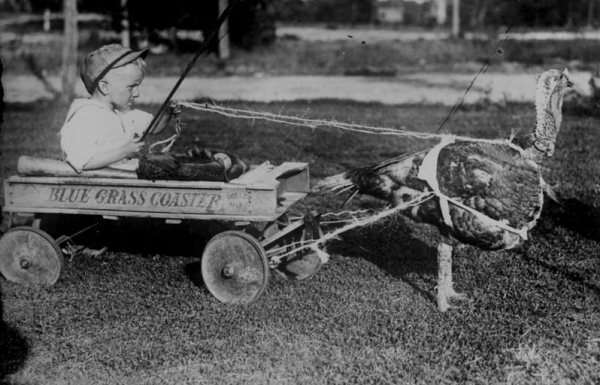
Transportation for the post-Fordistic
age?
We often wonder, who's gonna drive us home (and how)
when the automotive industry has vanished and the cars lay
broke. After Fordism there is Toyotism they say. But as Toyota
suffers as well, what will follow now? Without ref to the
country in the shown example photographed during the big depression
days 80 years ago, one may think of the possibiliy of turkeyism
which comes even leaner than lean manufacturing. The engine
is somehow self-sustaining and runs with seeds instead of
fuel. And we have to get used to a slow way of life. Both
aspects might not be only negative especially as values like
slow-reading and spending time offline getting popular again.
And we can still carry on! Just differently.
Source: Bundesarchiv via Wikimedia Commons
Present Day Minnesota
In order to understand the reaction of Minnesota libraries to the economic recession, it is important to describe the economic situation in Minnesota and the way libraries are funded in Minnesota.
Minnesota’s constitution mandates the state maintain a balanced budget (Article XI, section 6, Minnesota Constitution). As a result, as the recession has deepened, the Minnesota state budget has continued to be affected. The state has an estimated $426 million shortfall for 2009, which has resulted in a $229 million unallotment of funds (/www.mmb.state.mn.us/doc/budget/unallotment-08.pdf). The future does not look much better, with the January 2009 Economic Update describing the situation in the following way: “The U.S. economic outlook is, to put it charitably, grim” (www.mmb.state.mn.us/doc/fu/09/update-jan09.pdf). The November Forecast from the office of Minnesota Management & Budget predicts a $4.847 billion dollar shortfall for Fiscal Year 2010-11, 9.4 % below previous forecasts (www.mmb.state.mn.us/doc/fu/08/complete-nov08.pdf).
The way public libraries are funded varies slightly based on the type of library system, but the majority of library funding in Minnesota comes from property taxes. Considering the current financial crisis was caused by a crash in the housing bubble and has resulted in a precipitous drop in housing prices, it is worrying that the major stream of funding for public libraries in Minnesota comes from the ability to levy taxes on property.
The Kitchigami Regional Library System (KRLS) is a consolidated regional public library in northern Minnesota. There are two models for regional public library systems in Minnesota, the consolidated model and the federated model. In the consolidated model administration is consolidated at the headquarters. In the federated model administration is locally held in the branch libraries, with the headquarters only providing system wide services. Ramsey County Library System is a county library system, so all administrative power remains within one county. Kitchigami Regional Library System is a consolidated regional public library in northern Minnesota.
KRLS has two primary funding streams. The first
funding stream is derived from a levy or tax on city or county property
(www.revisor.leg.state.mn.us/statutes/?year=2008&id=134.07#stat.134.07).
The second funding source comes in the form of regional library
basic system support grants, which is also derived from property
taxes, but is distributed by the state (www.revisor.leg.state.mn.us/statutes/?year=2008&id=134.34#stat.134.34).
Another small source of funding is Local Government Aid (LGA). LGA
are tax monies collected by the state, which are then redistributed
to cities who use it to fund municipal services such as libraries,
police, and fire departments.
A basic budget breakdown for KRLS finds 70 % of funding going towards personnel, 20 % towards technology, and 5 % goes to collection development. KRLS serves an economically disadvantaged area. As a result they do not derive any of their funding from fines, because library users would not be able to pay and implementing fines would result in a greater loss of items.
KRLS has been lucky with staffing for 2009, as they have not yet had to reduce staff. However, the counties have made it known that cuts will be passed to the departments. Marian Ridge, director of the Kitchigami Regional Library System, states that she expects “3-4 extremely difficult years” ahead for the library system.
Ramsey County Library’s funding has already been affected by the economic downturn: 82 % of the Ramsey County Library’s funding comes from property taxes on the county level, 6 % from Local Government Aid (LGA), 7 % from fines, and the remainder from a number of miscellaneous sources. The LGA was unallotted in December and, according to Susan Nemitz, director of the Ramsey County Public Libraries, will be cut significantly in the future. Nemitz also reports that fines and other funds are down. However, the county property taxes remain stable at the moment.
Ramsey County Public Library’s budget strategy, as it moves through the turbulent economic times, includes benchmarking to demonstrate value, lobbying through the Minnesota Library Association (MLA) and Ramsey County, and by reducing spending with cuts to the book budget, implementing a hiring freeze, banning travel, etc.
Increases in Services
Kitchigami Public Library System has seen a great increase in a number of services. The greatest being a 32.5 % increase in the usage of the mobile library. This is indicative of library users’ response to the massive increase in gas prices during the fall of 2008. In addition, KRLS has seen a 14 % increase in circulation during the last year along with increased usage of computers. Ridge stated that computers at the library are often fully booked from the minute the library opens until closing time. According to Becky Walpole, a librarian in the KRLS, patrons are only allowed up to an hour per day on the computers, but no more than that due to high demand. Walpole also mentioned the affect increased library usage has had on staffing stating Walpole: “We usually have only one staff member on desk at a time, to allow others to do behind-the-scene things. We now often have two at the desk and at times, three.”
Ridge also cited a number of behaviors or uses of library services that are directly related to the effects of the economic recession. There are people who are giving up their high-speed internet lines and using the wireless at the library instead, people are using the computers to register for benefits online, people are printing out coupons and using the computers for comparative pricing, and families are using the library for more recreational material rather than buying it themselves.
KRLS has focused its efforts in responding to the needs of library users in a number of areas, the largest is the technology needs of users. KRLS has focused on providing more computers and maintaining broadband speeds. This is difficult, because whenever the branches add computers or broadband, there is a corresponding increased usage. This results in a constantly strained broadband.
KRLS has also responded to the educational and career related needs of the library users. The rural location of the library users precludes them from accessing traditional educational opportunities. Many library users can only afford to take university classes or continuing education classes online. Many people use the library to work on these classes. In addition to supporting distance learning, KRLS has also invested in online databases, that address the economic and career related needs of the users. For example, they have databases containing information about auto repair and maintenance as well as information on stocks, mutual funds, and health care services. Database usage has seen a 50 % increase over the last year.
Ramsey County Library has seen increases in usage of library services and resources in a number of areas. From 2007 to 2008 circulation has increased by 8.9 % (a new record), visits are up 5 %, public computer use is up 38 %, web site use is up 10 %, wireless network use is up 61 %, and computer class usage is up 23.7 %. Ramsey County Library is responding to this increase usage by increasing the bandwidth.
According to Nemitz, the biggest challenge they face is “flat staffing over the last 10 years with a 59 % increase in circulation”. At the same time Susan Nemitz does report a number of successes, including: convinced the county to invest $2 million in auto-handling and RFID, convinced the county to invest over $25 million in remodeling over the last five years, started a volunteer program, that last year provided 25,000 hours of service, and received over $100,000 in book donations last year.
Carry On
The economic recession means increased
use of and strain on library resources, all while coping with budgetary
restrictions. The past response to economic recession should help
guide libraries in the response they have to today’s economic
recession. Libraries should take action and be proactive in the
response to the challenges, that lay before them, they should publicize
the importance of the work libraries do and the services they provide,
and finally libraries should cooperate with other agencies who are
providing other social and government services.
In addition to learning from the past, the experiences of the Kitchigami
Public Library System and the Ramsey County Library can help shape
our understanding of what is going on at the ground level, as far
as the needs of users are concerned. Becky Walpole reminds us of
the vital role of libraries, when she states, “For many of
the patrons we serve, we are not a luxury, but a necessity”.
Finally, in response to the challenges the economic recession will
place on libraries, Ridge recommends taking the advice of a poster
from WWII, which reads “Keep Calm and Carry On”:

Reference List
American Library Association. (1933). Organizing citizens’ councils. Bulletin of the American Library Association, 27, p. 170-175.
Bureau of Labor Statistics. (January, 2009). Employment situation summary. Retrieved February 15, 2009, from, http://www.bls.gov/news.release/empsit.nr0.htm.
Catch-22. In Oxford English Dictionary (2nd ed.). Retrieved February 19, 2009, from Oxford English Dictionary Online database.
Lydenberg, H.M. & Milam, C. H. (1933). Basis for a citizens‘ platform. Bulletin of the American Library Association, 27, p. 57.
Lydenberg, H. M., Milam, C. H., & Gallagher, M. F. (1933). Citizens' councils: An open letter to A.L.A. members. Bulletin of the American Library Association, 27, p. 169.
Minnesota Constitution. Article XI, section 6. Retrieved February 18, 2009, from http://www.house.leg.state.mn.us/cco/rules/mncon/Article11.htm.
National Bureau of Economic Research. (December
11, 2008). Determination of the December
2007 peak in economic activity. Retrieved February 15, 2009 from,
http://www.nber.org/cycles/dec2008.pdf.
Media Reports about increased library usage:
New York Times
http://cityroom.blogs.nytimes.com/2008/08/01/are-economic-woes-pushing-up-library-circulation/?hp
CBS News
http://www.cbsnews.com/video/watch/?id=4771080n
National Public Radio
http://www.npr.org/templates/story/story.php?storyId=93041368
Minnesota Public Radio
http://minnesota.publicradio.org/display/web/2008/12/18/with_the_recession_library_usgage_on_the_rise/
?refid=0