- Introduction
- Intertextuality
- A Strategy to Support Boundary Crossing
- Methodology
- Intertextual Designs in Action
- Intertextuality and Boundary Objects as Components of Learning Design
- Acknowledgments/References
Introduction
Informal learning environments (ILEs) such as public libraries, Boys & Girls Clubs, and school-based child-care programs provide supervision of children during afterschool hours. They are said to perform important community functions such as providing a safe, pro-social environment for their child participants. In their 1982 essay, Patricia M. Greenfield and Jean Lave (Greenfield & Lave, 1982) suggest that, (in American settings), distinctions between formal education (FE) and informal education (IE) may be based on dichotomies associated with context, responsibility, intimacy, curriculum, continuity, mode of learning, mode of instruction, and social motivation. Along similar lines, Sylvia Scribner and Michael Cole (Scribner & Cole, 1973) draw distinctions between informal learning and literacy and those competencies acquired in school. Each of these authors maintains that it is useful to talk about informal learning environments as contexts separate from school due to their rich potential for supporting productive and transformative learning. In addition to this work relating to informal learning environments, a body of research concerned with new conceptions of literacy as multi-modal, culturally situated practices has emerged. Attempts to infuse learning designs with popular and youth cultures have gained momentum – seeking to capture the potentiality for more motivating and engaging learning contexts. As examples of this line of inquiry, the new literacies work developed by Leu, Kinzer and their extended workgroup (2004), the multiliteracies pedagogical framework articulated by the New London Group (1996, 2000), the broadly based popular literacies work from Ann Haas Dyson (1997, 2003), and research in digital environments from David Buckingham (2003) provide a rich set of tools to think about learning design and the content and rationale for technology integration and instruction for informal learning environments.
Dyson’s important work integrating popular stories with school-sanctioned narratives demonstrates how children can use their cultural narratives as a base from which to work from as they encounter school-sanctioned texts and diverse lifeworlds. Finders (1997) also shows how girls’ private, informal literacy practices have real consequences for their social and emotional development. In each of these cases, the author calls for popular texts to be appropriated by classrooms to support not only skills acquisition but to provide spaces where dialog and critique of popular narratives can play out. Most afterschool ILEs incorporate popular culture to a great extent. I think the goal achieved by Dyson was the successful meshing of popular and adult-sanctioned texts through reading, writing, artwork, and dramatic play. This work has influenced my approach to learning design in that I attempt to use youth cultures (as instantiated in popular games, play practices, and texts in the Fifth Dimension) as textual gateways to new practices centered around media, information, and computer literacy. In this paper I illustrate how popular culture texts can lead to engaging and transformative practice when infused in to the programming of an afterschool informal learning environment. To do this I present two examples of activities designed to leverage intertextual relationships between popular and educative texts and practices to support information and visual literacy.
Intertextuality
As a concept, intertextuality emerged from semiotic theory (Kristeva, 1980) to describe the process by which individuals come to know a particular text through their prior experiences with other texts. Jay Lemke (1998) uses the concept of intertextuality extensively to drive home the point that literacies are “always social: we learn them by participating in social relationships; their conventional forms evolved historically in particular societies; the meanings we make with them always tie us back in to the fabric of meanings made by others (Lemke, 1998, p.2).” The idea that literacy learning is most effective when it is socially situated and part of an intertextual chain of meanings (relevant to students) gives researchers concerned with literacies in ILEs a new way of thinking about the introduction of new practices.
A Strategy to Support Boundary Crossing
By introducing intertextuality as a (learning) design element, I felt I could use popular culture/youth culture narratives to initiate intertextual chains, creating new linkages between popular texts and adult-sanctioned texts, competencies, and ways of viewing the world. In this way, the intertextuality-infused designs could be leveraged as a means of helping children “cross boundaries” toward practices related to new literacies and movement toward mastery of existing competencies. This notion of boundary crossing is informed by concepts developed first by Susan Leigh Star (Star, 1989; Star & Griesemer, 1989) and further developed by Yrjo Engeström (Engeström Y. & Kakkainen M, 1995), Terttu Tuomi-Gröhn (Tuomi-Gröhn & Engeström, 2003), and Richard Edwards (Edwards, 2005). Much of this work describes the processes of boundary crossing in which an individual moves beyond their primary sets of professional practices and realms of expertise. Along similar lines, the concept of boundary objects has helped to articulate the ways in which tools and artifacts support and provide infrastructures for such “crossings over” between different communities of practice.
Boundary objects are those objects that both inhabit several communities of practice and satisfy the informational requirements of each of them. Boundary objects are thus both plastic enough to adapt to local needs and constraints of the several parties employing them, yet robust enough to maintain a common identity across sites. (Bowker & Star, 2000) I suggest that theories of boundary crossing and boundary objects provide powerful means of conceptualizing and describing the uptake of tools and new practices among child participants. Considerations can be made about whether an activity design was relevant as a tool to support learning by framing the issue in terms of whether participants were engaged to the extent that they tried something new or stretched their existing repertoires of practice. Along similar lines, Etienne Wenger (1998) suggests that movement between communities of practice is oftentimes mediated by brokers. For Wenger, brokers are individuals that have expertise and relationships located in multiple communities of practice and are willing to extend practices found in one community toward individuals relegated to a different sphere of expertise and participation.[Brokering] …requires the ability to link practices by facilitating transactions between them, and to cause learning by introducing into a practice elements of another. Toward this end, brokering provides a participative connection – not because reification is not involved, but because what brokers press into service to connect practices is their experience of multimembership and the possibilities for negotiation inherent in participation. (Wenger, 1998, 109)
Thus the goal of the project was to design activities mediated by specially designed artifacts (intertextual taskcards – to be described in depth later) and guided by adult brokers (researchers and service learning students) to support boundary crossing by the children toward new practices associated with digital production and information and visual literacy. In the section that follows, I will highlight the setting for this approach: a well-developed afterschool program, the Fifth Dimension (5D), which has a fairly long history of creating contexts for children’s access and meaningful participation in activities related to new and basic literacies.
Methodology
Setting for the Study
The Fifth Dimension Project, begun by Michael Cole and Peg Griffin in 1987, formed a university-community collaboration that places undergraduate students from the fields of Psychology, Communication, and Human Development in an afterschool program where they worked as field ethnographers conducting qualitative research while they engaged in homework help and educative play activities with K-6 child participants. An experiment in informal leaning design, Fifth Dimension research has influenced and drawn on work informed by the Design Experiment approach initially introduced by Ann Brown (1992). Like Brown and others associated with design experiment research, the digital storytelling project described in this paper supports new approaches to designing instructional activities while contextualizing interventions within localized practices and contingencies.
Ethnographic Observations
Adult, undergraduate participants recorded much of the activity as it enfolded in ethnographic fieldnotes. Undergraduates (between 15 and 20) attended the Fifth Dimension at the Fair Hills and Polvera Boys and Girls Clubs two times a week and authored fieldnotes detailing their participation and interactions. Educative play activities taking place at the sites included participation in: (a) console and pc-based video gaming, (b) art projects, (c) board games, (d) multimedia production projects, (e) web-based information seeking and (e) web design. Hundreds of fieldnotes were collected during the two and a half years of observation. I performed coding and analyses allowing me to chart and characterize participation in various activities through observations made by adult, undergraduate participants in the Fifth Dimension.
Child Questionnaires and Interviews
Prior to participation in the Fifth Dimension sites, children completed an application in which they provided biographical information (e.g. name, age, gender, favorite movies/activities). This application performed an instructional function in that it organized a set of tasks for children to complete with their undergraduate buddy which introduced them to activities related to searching the web, digital photography, manipulating a computer, geography, etc. Children were interviewed periodically concerning their web design and video production projects. The digital audio recordings of these interviews provided data which further informed my understanding of how social transformations were articulated through participation in activities integrating technology, information seeking, and multimedia production.
Designworks
Relevant artifacts for analysis included disks provided to children (for saving desired games, webpages in progress, photos, artwork, homework, letters, etc.), handwritten documents and artwork, and multimedia production projects (e.g. digital stories). Content from children’s disks was uploaded to folders on a server at the end of each week. A separate folder was prepared weekly for each child. The weekly children’s folders were then placed in an aggregate “cohort” folder to render a complete collection for each week. Artifacts produced in the Fifth Dimension provide additional evidence that children engaged in particular activities such as reading, writing, media production, and web design during a particular timeframe. Because the Fifth Dimension provides such a rich source of ethnographic observations, child questionnaires, and examples of designworks to communicate these ideas, the research design allowed for triangulation between data collected from observations of children inscribed in fieldnotes, statements children made about themselves (in applications and interviews), and designworks created by children as part of their participation in the learning designs that were part and parcel of this study.
Intertextual Designs in Action
In the sections that follow I highlight two cases which demonstrate how intertextual gateways were infused in to the design of activities for children in an afterschool learning environment. The concept of intertextuality was applied to the design of an organizing activity already common to the Fifth Dimension: the taskcard. For the remainder of this chapter, I highlight two approaches I took in developing new taskcards for the Fifth Dimension. First, using video games as gateways to exploring web-based searching and digital production, and second, using holiday activities to build visual literacies. Over multiple ten week periods, our research sites at the Fair Hills and Polvera Boys’ & Girls’ Club introduced one or two new taskcards every day. As mentioned previously, the taskcard designs incorporated Kristeva’s notion of intertextuality in that youth cultures were understood as texts that could be strategically leveraged to initiate intertextual chains of meaning towards new, educative texts and practices (see Figure 1).
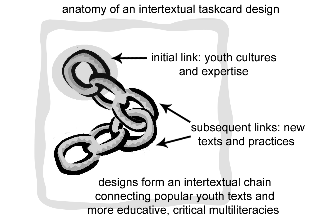
Figure 1 Anatomy of an intertextual taskcard
I focus first on the case of Skyler (10 years old), who, through participation in the intertextual learning design activities (brokered by an undergraduate service learning student) built competencies related to information and computer literacy and producing a personal webpage. The second case involves the use of taskcards designed to leverage children’s interest in a popular American holiday, Halloween, to support engagement in activities related to building visual literacies. Halloween occurs in October and involves the carving of pumpkins (a type of squash) which are illuminated with candles. Children dress up in costumes and walk door to door begging for candy – a practice called “trick-or-treating.”
Games as Intertextual Gateways: Supporting Information Literacy and Digital Production
The activity design as shown below at the Fair Hills Boys and Girls Club Fifth Dimension was organized around a “taskcard” format (common to the 5D) with beginner, good, and expert levels of expertise. The activities took participants through increasingly complex tasks grounded in children’s participation in a popular pc-based video game, “Zoo Tycoon”. The “Zoo Tycoon Activity Page” represents a second Zoo Tycoon taskcard for children to choose from, thus providing another set of activities related to the popular game. At the beginner level, the child extends the context of the game toward the goal of finding tips and hints on the web and testing their viability in the game. At the good level, the child tests and saves their tips and hints into an electronic file. Finally, at the expert level, the participant inserts this file into a personal webpage.
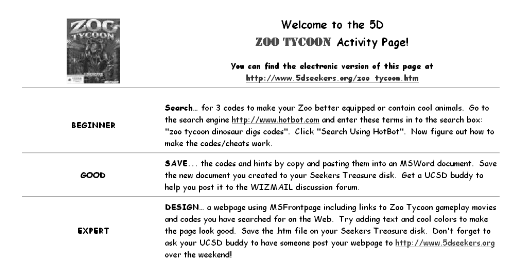
Figure 2 Intertextual Taskcard: "Zoo Tycoon Activity Page"
In the fieldnote that follows, an undergraduate
describes an interaction that was guided by the taskcard describe
above. This “intertextual” taskcard was designed to
support the acquisition of information literacy by supporting the
child’s movement beyond participation in a favorite video
game to practices related to searching the web, reading text on
a computer screen, and the critical application of information found
through the search process. Skyler (a 10 year old boy) visited the
Fifth Dimension after school with his sister Melissa. I asked Skyler
if he knew what a search engine was. He said that he didn't, and
I explained that it was a website you go to in order to search for
things. I showed him how the search results were of websites based
on the subject he typed in. We went to several of the links in order
to find one that had some tips on it. We found one, and I asked
Skyler if he knew how to copy and paste selections. He said he didn't,
and I instructed him on how to do so. I told him to highlight what
he wanted to copy, and he did so
…Skyler found another one on a website and became excited,
turning to Raymond sitting to his left and explaining the code to
him with a jazzed tone of voice. Skyler copied and pasted the new
codes into the Notepad document, then we spent some time reading
the next directions on the task card [NED: 11/9/04]
In the example above, the undergraduate was able to extend one child’s agenda for playing a video game toward more educative practices. Movement from a context bound by the game itself to one where the child became engaged with new practices (related to working with virtual objects, searching the web, and applying relevant information to a set of problems) was accomplished through processes of “intertextual chaining”. At the Expert level of taskcard Skyler came to build a webpage via completion of the Zoo Tycoon taskcard (see figure 2). We were looking for a computer when Maria asked Skyler if he wanted to build a webpage. Skyler agreed so Maria and I went to look for the task card for Microsoft Front Page.We went on the web and looked for an image of Zoo Tycoon. Skyler picked one and I showed him how to save it onto the hard drive. Just then Maria came over and suggested we save it onto the disk. The picture Skyler had chosen was too small and it was replicated all over his background page. He didn't like it so we were going to open it up in paint and see if we could make it bigger but when we opened up his disk, Maria saw that he had an old picture of the Lord of the Rings and he opted for that one instead. He made the picture bigger in Paint and then opened it up in Front Page, as a background. By this time Skyler knew how to open it up the background on his own. Then we went to Word Art under Insert on the menu and he picked the design and the title of his page: Lord of the Rings. We then went online again to Google and searched for pictures of the lord of the rings. For these pictures, it didn’t matter if they were small because we could adjust them. He found about four pictures and saved them all onto his disk. He then opened them up on front page and inserted them onto his first page. Then we opened up a new page and inserted an old table we had saved a while ago with all of his cheat codes. The table was already saved neatly on Microsoft Word so we just inserted it onto the new sheet. Then we changed the color of the table to make it match the title he gave it. He once again used Word Art and typed Zoo Tycoon above the Cheat Codes Table. I suggested that he include a hyperlink on the page to the Zoo Tycoon website. So we searched the menu to find out how to do it until we finally found it. Then we went to Google again to look for the website. Once we found it I showed Skyler how to copy and paste. We pasted the URL into the hyperlink window and there it was on the screen. Then I suggested he change the color of the Hyperlink to match the rest of the page. So he highlighted it and changed it to red [LT: 11/4/04].
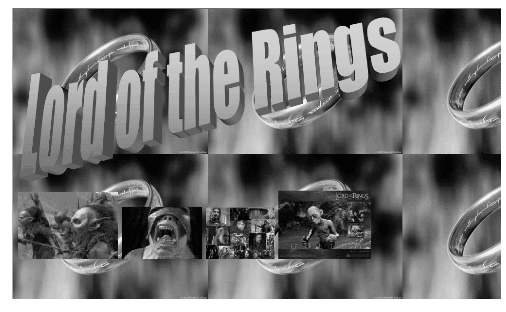
Figure 3 Screenshot: Skyler's personal webpage.
The Zoo Tycoon activity page (see Figure 2) was a highly engaging design that introduced practices such as searching the web, manipulating and applying information gleaned from this process, and building a personal webpage. An attempt was made to create a taskcard that was permeable to the discourses and lifeworlds children bring to literacy events (in this case interests in computer gaming) while engaging them (via intertextual chaining) in literacies related to participation in electronic discourses and problem solving. The anecdote detailing Skyler’s experience demonstrates the potential exists for creating spaces where learning events are contextualized in ways that are responsive to children’s goals and popular interests.
Holiday Texts and Practices as Gateways: Supporting Visual Literacy
Gunter Kress’ writing (Kress, 1999) on multimodality suggests that communication in the information age is inherently a process that involves more than just reading and writing. Students must be fluent in multiple media discourses related to verbal and non-verbal communication. In a similar manner, the new literacies approach emphasizes the importance of students gaining competencies not just in reading text but in applying strategies for reading off-the-screen, understanding images, interpreting colors, and navigating infrastructures for information retrieval (Coiro, 2003; Leu, Kinzer, Coiro, & Cammack, 2004; Sutherland-Smith, 2002). Following this approach for the design of intertextual taskcards, the emphasis was on providing activities in which participants were exposed to a variety of resources in multiple modalities. In the “Personal Pumpkin” taskcard (see Figure 4) children interacted with and manipulated images using a popular drawing program, Microsoft Paint. They learned about relationships between symbols and actions on the screen and how images can be modified electronically through the use of color, line, and text to create different visual effects. At the heart of this taskcard was the idea that children should begin early to understand the ways in which images can be modified electronically to convey multiple meanings. Bound up in this goal is the desire for the participants themselves to become versed in the visual literacies that allow individuals to understand graphical iconography and associated electronic tools and applications.
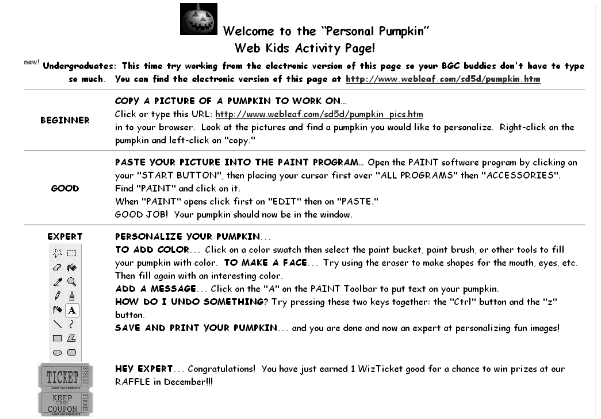
Figure 4 Intertextual Taskcard: "Personal Pumpkin"
Jackie (age 10) & Veronica (age 11)
Here, I highlight the two cases of Jackie (age 10) and Veronica (age 11). An undergraduate service learning student, SCS, was able to participate with the girls to complete the “Personal Pumpkin” taskcard (see Figure 4): First up were two girls by the names of Jackie (5th grade) and Veronica (6th grade). We had some trouble getting on the webpage given to us at first, but we were up and going with some help from Maria. Once on the webpage, the two girls were to pick their favorite pumpkin out of three and copy + paste it into Paint. On Paint, the girls began to customize their pumpkins by digitally coloring them, and then drawing faces on them. While both girls had no trouble going through the tasks, Jackie was definitely more independent while working. Veronica, on the other hand, asked for my input on whether she should do something or not. She asked about which buttons did which and how she could make better lines. Veronica completed the task card first, possibly because she wasn’t afraid to ask for help when she needed it. [SCS: 11/1/2005]

Figure 5 Veronica's Personal Pumpkin (6th grade)
SCS provided the girls with space to work on the task themselves, only helping out when explicitly asked. The discussions that SCS and Veronica had about the icons in Microsoft Paint and how to draw more controlled lines respond directly to the goals I had for the taskcard in that after working through it, Veronica and Jackie had crossed certain boundaries toward understanding how images can be modified and had engaged in some of these practices themselves. In addition to these practices related to visual literacy, they engaged in tasks that required the manipulation of graphical objects and electronic files. For these students close to entering or just entering middle school, moving towards mastery of working with electronic files and graphics will undoubtedly support their ongoing education.
Auggie (age 8) and Bran (age 9)
Whereas Jackie and Veronica completed the Personal Pumpkin taskcard with no difficulty, two eight and nine year old boys (working as a pair) found greater challenges in modifying a pumpkin for Halloween. From MAM’s fieldnotes, there seemed to be excitement about the project because Halloween is such a beloved holiday but the task itself wasn’t easy. First, the children had to learn what the symbols in Paint mean and then manage to control them. In the fieldnote below MAM describes the children learning this process. In the first trial Auggie selected the pumpkin in the middle of the site and then he began to experiment with the pumpkin by himself in paint bucket. Auggie had trouble like Bran in controlling the paint bucket coloring device in his pumpkin picture. Most of the time Auggie just wanted to colors a certain area of the pumpkin and he would end up painting everything; Bran did the same with his picture and his paint bucket device. In one of the times that Auggie used the paint bucket I had to tell him that in order for him to not spill the paint all over the painting I told him that he need to outline the area that he wanted to the paint to stop flowing to with a different color from the paint. Auggie listened to me and he outlined the teeth of his jack-o’-lantern so the color orange would not spill into the teeth or the outer area of the pumpkin. [MAM: 10/25/05]
When MAM provided Auggie and Bran with a solution to the problem of color not staying where they intended, it was really a way of suggesting that the outlines of the image can indeed be modified. Once Auggie realized that he could add not only color, as a child would do to a coloring book, but add the lines to the object as well, he was able to move forward with the activity. Bran, on the other hand, struggled with this concept and attempted to implement a different strategy. With Bran I tried to teach him the same technique but he seems to not understand what I was telling him because he did not does as Auggie. Instead, Bran would get either the pencil or the brush and he would start to color piece by piece the area of his desire instead of just outlining the area with a different color and then spelling paint with the paint bucket. [MAM: 10/25/05]
The ability to think strategically about how
to use the drawing software, to add components, and edit existing
areas with color was challenging for Bran. His alternative solution
to the problem of controlling the paint bucket tool is interesting,
however, in that Bran was able to find out (in a very short period
of time) that the modifiable surface area associated with other
tools was precise enough to allow him to have satisfactory enough
control over color to meet his goals for the pumpkin (see Figure
6). MAM’s work with Bran and Auggie supported their movement
beyond a popular holiday activity for kids, a pumpkin art activity
for Halloween, toward new technology-based practices associated
Figure 6 Bran's Personal Pumpkin (age 9) The Personal Pumpkin taskcard presented permeability
to youth culture and leveraged the excitement children felt surrounding
an impending, popular American holiday. Perhaps this motivated children
to both begin as well as complete the challenging activity. Furthermore,
the excitement about the impending arrival of Halloween is one reason
that children such as Bran, who experienced great challenges in
completing the taskcard, were still motivated to pursue the activity
to its finish. In addition to engagement with Halloween, the children
highlighted in the above cases seemed to benefit from the feedback
they received from the practicum students that brokered interactions
with the taskcards. Boundary crossing toward new practices in the
cases of Jackie, Veronica, Auggie, and Bran was supported by patient
brokers who ascertained very quickly, in the moment really, what
approach to take with the children to introduce new practices while
maintaining the children’s interest. Richard Edwards, in a 2005 conference presentation
argued that “identifying and designing boundary objects that
enable a change of horizons in learning may therefore enable the
border crossing from one domain to another and support learning.”
It is in this same spirit that we ventured to design a set of activities
that would act as boundary objects to support children’s participation
in new practices associated with information, visual, and other
multiliteracies. Afterschool programs are ideally situated to pave
the way toward creating programming inhabited by educative and engaging
practices due to their flexibility and, in this case, strong partnerships
with other community organizations. One of the greatest challenges
involving program design involves devising a way to design activities
that are both intellectually enriching and engaging. Activities
that leverage children’s interests and youth cultures represent
one approach to developing meaningful and transformative programming
for children participating in afterschool programs. As evidenced
by the experiences of Skyler, Veronica, Jackie, Auggie, and Bran,
when children’s goals can coexist and enrich those of designers,
intervention design for youth participants is at its most relevant.
I want to thank Michael Cole and my colleagues at
the Laboratory of Comparative Human Cognition at the University
of California, San Diego for the continued support of my work. Bowker, G., & Star, S. L. (2000). Sorting things
out: Classification and its consequences. Cambridge, MA: The MIT
Press. Brown, A. L. (1992). Design experiments: Theoretical
and methodological challenges in creating complex interventions
in classroom settings. Journal of the Learning Sciences, 2, 141-178. Buckingham, D. (2003). Media education and the end
of the critical consumer. Harvard Educational Review, 73(3), 309-327. Coiro, J. (2003). Reading comprehension on the Internet:
Expanding our understanding of reading comprehension to encompass
new literacies. The Reading Teacher, 56(5), 458-464. Cole, M. (1996). Cultural psychology: a once and future
discipline. Cambridge, MA: The Belknap Press of Harvard University
Press. Dyson, A. H. (1997). Writing superheroes: Contemporary
childhood, popular culture, and classroom literacy. New York: Teachers
College Press. Dyson, A. H. (2003). The brothers and sisters learn
to write. New York: Teachers College Press. Finders, M. (1997). Just girls: Hidden literacies
and life in junior high. New York: Teachers College Press. Engestrom Y., & Kakkainen M. (1995). Polycontextuality
and boundary crossing in expert cognition: learning and problem-solving
in complex work activities. Learning and Instruction, 5(4), 319-336. Greenfield, P., & Lave, J. (1982). Cognitive aspects
of informal education. In Cultural perspectives on child development
(pp. 181-207). San Francisco: W.H. Freeman and Company. Hull, G. & Katz, M. (2006). Crafting an Agentive
Self: Case Studies of Digital Storytelling. Research in the Teaching
of English, 41(1), 43-81. Kajder, S. (2004). Enter Here: Personal Narrative
and Digital Storytelling. The English Journal, 93(3), 64-68. Kajder, S., Bull, G., & Albaugh, S. (2005). Constructing
Digital Stories. Learning & Leading with Technology, 32(5),
40-42. Kress, G. (1999). Multimodality. In Multiliteracies:
Literacy learning and the design of social futures (pp. 182-202).
New York: Routledge. Kristeva, J. (1980). Desire in language: A semiotic
approach to literature and art (T. Gora. A. Jardine & L. Roudiez,
Trans.) (L. Roudiez, Ed.). New York: Columbia University Press. Lambert, J. (2007). Digital storytelling cookbook
and traveling companion (Vol. February). Retrieved March 13, 2007,
from Center for Digital Storytelling Web site: http:/?/?www.storycenter.org/?cookbook.pdf Lemke, J. (1998). Metamedia literacy: Transforming
meanings and media. In D. Reinking, L. Labbo, M. McKenna, &
R. Kiefer (Eds.), Literacy for the 21st century: Technological transformation
in a post-typographic world (pp. 283-301). Hillsdale, NJ: Erlbaum. Leu, D., Jr., Kinzer, C., Coiro, J., & Cammack,
D. (2004). Toward a theory of new literacies emerging from the Internet
and other information and communication technologies [Electronic
version]. In R. Ruddell & N. Unrau (Eds.), Theoretical models
and processes of reading (5th ed., pp. 1570-1613). Newark, DE: International
Reading Association. The New London Group. (1996). A pedagogy of multiliteracies:
Designing social futures. Harvard Educational Review, 66(1), 60-92. The New London Group. (2000). A pedagogy of multiliteracies
designing social futures. In B. Cope & M. Scribner, S., & Cole, M. (1973). Cognitive consequences
of formal and informal education. Science, 9(4112), 553-559. Scribner, S., & Cole, M. (1981). The psychology
of literacy. Cambridge, MA: Harvard University Press. Star, S. L. 1989. The structure of ill-structured
solutions: boundary objects and heterogeneous distributed problem
solving. In Michael N. Huhns (Series Ed.) & Les Gasser (Vol.
Ed.), Morgan Kaufmann Series In Research Notes In Artificial Intelligence
(pp. 37 - 54). San Francisco: Morgan Kaufmann Publishers Inc. Sutherland-Smith, W. (2002). Weaving the literacy
web: Changes in reading from page to screen. The Reading Teacher,
55(7), 662-669. Tuomi-Gröhn, T., & Engeström, Y. (Eds.).
(2003). Between school and work: New perspectives on transfer and
boundary-crossing. London: Pergamon. Wenger, E. (1998). Communities of practice: Learning,
meaning, and identity. Cambridge, England: Cambridge University
Press. Kristen Radcliff Clark is Assistant
Professor at the School of Library
& Information Science der San Jose State University.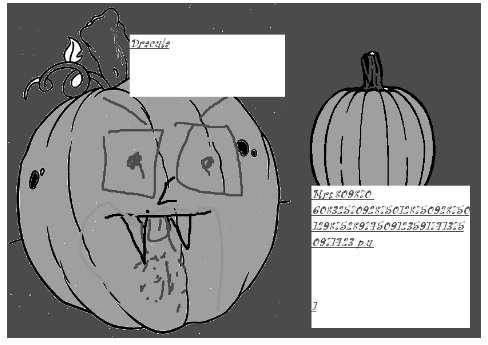
Intertextuality and Boundary Objects
as Components of Learning Design
Acknowledgments
References
Edwards, R. (2005, July). Contexts, boundary objects and hybrid
spaces: Theorizing learning in lifelong learning. Paper presented
at the 35th Annual SCUTREA Conference, Falmer, East Sussex/UK.
Engestrom, Y. (1987). Learning by expanding: An activity-theoretical
approach to developmental research. Helsinki, Finland: Orienta-Konsultit.
Kalantzis (Eds.), Multiliteracies: Literacy learning and the design
of social futures (pp. 9-38). London: Routledge.
Star, S. L., & Griesemer, J. (1989). Institutional ecology,
'translations' and boundary objects: Amateurs and professionals
in Berkeley's Museum of Vertebrate Zoology, 1907-39. Social Studies
of Science, 19(3), 387-420.